Saturday, July 5, 2014

GYEONGJU

One of my favorite Korea experiences was our trip to Gyeongju, the capital of the ancient kindom of Silla (57 BC-935 AD). I am always amazed by the dates we often see as we visit historical sites. I am also fascinated by what we can learn about a people who lived so very long ago.

Meet Justin and DaNese. They are standing in front of the oldest astronomical observatory in East Asia, built during the reign of Silla Queen Seondeok. Justin is one of our young soldier friends. In fact he has become like family. We were so happy that his sister came to visit him here in South Korea. It was fun getting to know her. It was even more fun listening to their family stories and good natured sibling banter. They reminded me of our own kids who love to tell stories of their childhood and to tell on each other!  Justin had already been to Gyeongju so he was our tour guide. It is an amazing place. Between the four of us we took hundreds of pictures. I will try to share a few, just a few!

The temple grounds and the royal compound had many fascinating structures. On the right is a stone ice storage made of about 1,000 stones with a mounded roof and three ventilated ducts. This is a really ancient refrigeration system!

The grassy hills on the left are actually burial mounds. They hold the remains of the royal family members of the Silla dynasty. 

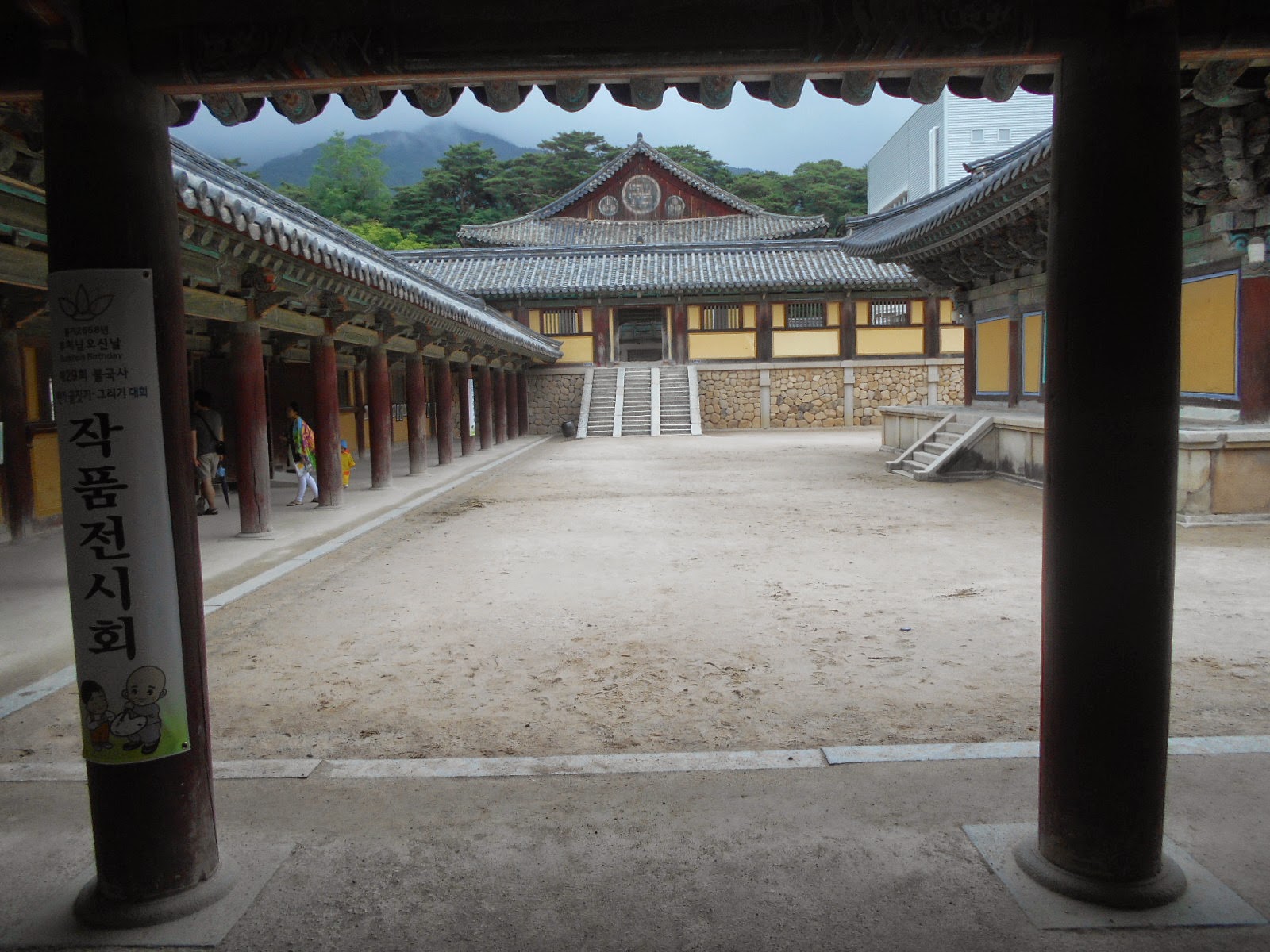
This court yard is surrounded by covered walk ways. The temple is above. The pagoda on the right is one of several you pass as you walk through the beautiful grounds.


The shrine on the left is in a section of the courtyard. Some of the Koreans visiting while we were there stopped for a moment to  offer a prayer.

The picture on the right is one of many lotus ponds we saw. The lotus blossom is significant in Buddhism. 


We are so blessed to serve here and to enjoy many Korean experiences. I like to say "sometimes we are Elder and Sister Fairhurst, but sometimes we are just Fred and Susan in Korea.


Friday, June 13, 2014

Saeng il chuka habnida


Korean Happy birthday
We had another amazing Korean cultural experience last week. Our friend Sup invited us to his nephew's first birthday. They really know how to throw a first birthday celebration here. The party was held at a professional event center which focuses mostly on first birthday parties.

A display of professional pictures and a video which looped again and again was placed just outside the door of each little one year old's assigned party room. In the common area there was an amazing buffet for all the guests. The private party rooms were decorated and set up for some traditional activities. We signed in at a digital screen that took a picture of us as we signed our names. It was basically a digital birthday card/guest book that the parents would receive after the party. The food from the buffet was delicious, beautiful and apparently Korean- or at least nothing we've had at parties at home. We sat at long tables eating our food and waiting for the festivities. An unusually tall and quite boisterous Korean was our emcee. As soon as he grabbed the mike the gathering became very Las Vegas like! There was loud music and flashing lights. He told lots of jokes, well he spoke Korean so I assume he was telling jokes because everyone was laughing.


He also dragged Fred up to the front and challenged him to dance Gangnam Style. Fred is a good sport, but he performed his own version of the sprinkler dance instead. Yep it was pretty funny, but I was too stunned to think to grab the camera. Not only did his dancing talent earn him cheers and applause, but he also won a gift of a birthday mug.


Hyeon (Sup's nephew) made a grand appearance mid cheering, "oos" and" ahhs". He was wearing hanbok and riding in a mini Audi remotely controlled by his proud dad. His parents were also dressed in the traditional Korean celebratory hanbok.


One of the  first birthday traditions is called toljabee.  Here is a definition: "In this event, the child is seated before a table on which various items have been placed for the child to pick from. Traditionally, Koreans think that the first or second item picked by the child foretells his or her future. For instance, if the items picked are a book or pencil, then people think the child will be a successful scholar; if rice or money, the child will be wealthy; if thread, the child will have a long life.

The tradition may be slightly modified. At the party we attended the guests had a chance to predict the item the child would select by placing their ticket in one of several goblets, each with an image of one of the items. The child is shown a tray with the items on it. When he chooses one, a ticket is drawn from the corresponding goblet and the guest whose number is drawn receives a gift. Hyeon's parents were pretty excited when he grabbed a 50,000 won bill ($50.00) and began chewing on it!

We asked Sup about the cost of such an event. He said it cost his brother about $1,000 (American). His brother and sister-in-law had saved for nearly the whole year for this celebration. Why? Why would they spend so much money on an event their child will only remember through pictures? To some of us it may seem extravagant. It may seem like the money could be better spent on necessities. As I learned the history upon which this tradition is based, I understood much more.

Here's a brief explanation:  "Long ago in Korea, childhood diseases were common and the survival rate for children was very low. To protect their children, parents refrained from taking the baby outdoors until the 100th day after his or her birth. It is not until baek-il (100 day)that the baby was introduced to neighbors, friends and relatives. One of the baek-il’s  special events is the parents providing rice cakes, called baekseolgi, to at least 100 people. They believe this event helps to protect the child’s life. They also pray for the child’s continued good health. A child’s first birthday party, or tol, is a big celebration."

What would it have been like to fear taking your children out for the first hundred days? To be so unsure of your child's survival that you would not show them to friends and family. Then to celebrate the 100th day only to hope and pray they would survive the first year. We are so blessed today. We assume our children will live to adulthood. We do not expect to lose them in infancy. We show them off as soon as possible. In the unexpected event that a child dies before the age of one, families mourn and grieve together. But it seldom changes the expectation that future babies will survive.

So I say celebrate! Indulge in some extravagance if you want to. We all need to remember the precious gift of life and never take it for granted.

Thursday, June 12, 2014

Twelve down and six to go!

Our FHE group exiting our apartment
 in our elevator. A little like keystone
cops in a phone booth!
June 10th marked one year of our eighteen month mission. In most ways that fact is very hard to believe, but then again some days still seem more like a week than 24 short hours. We continue to enjoy our Korea mission as we share our home, our time and our beliefs with those we meet. We are blessed to participate in  cultural traditions and see historic sites rich with meaning. Other times we are amused by the differences between what we see in Daegu  and our life in Montana!. We have come to say often "That is so Korea".  Before I continue I need to offer a disclaimer. We mean no disrespect by that term. We have grown to love and respect the Korean people. Many of the things that amuse us are the result translations. We just appreciate the Korean's efforts to cater to English speaking foreigners. Finding humor in the differences goes both ways. I am sure they often think "That is so America". So I hope you enjoy some pictures and descriptions of a few things that make us say....

that is Just So Korea!

Our small congregation gathered for a "Memorial Day Extravaganza". It started with a morning hike up Apsan. As you may know from previous posts, this is one of my favorite places in Daegu.   This time we went a little different direction and were able see some Buddhist temple structures. The mountain was
 so beautiful and peaceful.

Here's a little treat I bought for Fred at a walk up snack shop on the narrow street behind our apartment. The drink size cup is filled about half full with Pepsi. Then the smaller cup fits into the top half of the drink cup just above the Pepsi. The smaller cup has a little round hole used to put the straw through. Then sweet & slightly spicy Korean chicken chunks are placed inside the cup. Ingenious and quite delicious all for 1,000 won. McKorea nuggets!


When you make a doctor's appointment here it is almost always at a hospital. Very few doctors have private offices elsewhere, but there are a few exceptions. Fred thought this doctor's office was the perfect combination... skin and stones! With his recurring minor skin cancers and kidney stones it certainly would be convenient. You also see quite a few plastic surgeon offices as you walk through town.


 I don't think Korean people in general are squeamish about much. If so it's not over the same things that make me squirm.  I am amused by the signs designed to draw people  into restaurants. I kind of get those with cartoon animals and  pictures of cooked meats. After all we do the same at home  What I don't get is the pictures of real animals they use to entice you to come in so you can eat them in their butchered form. Not cartoonish or even very appealing in any way. Pictures of mangy, dirty looking animals in living form do not make me hungry for pork, or beef or fish. For that matter it doesn't work for octopus or eel ether. But then again short of starvation, nothing would probably make those appealing to me!

Translation of Korean to English is quite a challenge. The differences in sentence structure, conjugation and general grammar make direct translation sometimes awkward and often humorous. This sign outlining rules of the park is just one of many examples. I find a few of its warnings very entertaining.
--Disorderly acts, such as shouting and singing noisily with drunkenness in the park, act of drinking, playing "flower cards" on the street. etc.
--Act of neglecting to collect the droppings of pet animal accompanied.
--Act of making others feel hatred, such as noise and bad smell. (This one pretty much eliminates all teenagers from hanging out in the part)

These examples are just a small sampling of the sights and experience that delight and entertain us. We love it when we carefully and very slowly sound out the words on a Korean sign only to discover it's "Konglish"- Korean versions of American words such as tomato, computer, or taxi. We smile at the older ladies pushing the baby strollers filled with fuzzy white dogs they are "taking for a walk". We are touched at the random gifts we receive from strangers ... a few small melons, a handful of nasty ginseng candy, a homemade bath scrubber. So check the blog out again in the future, because "much more come will"!


Wednesday, June 4, 2014

Our Hagwon Experience

As missionaries our first purpose is to invite others to come unto Christ. This is an important and meaningful assignment which we attempt to accomplish in a variety of ways. This is an assignment we first accepted upon baptism into The Church of Jesus Christ of Latter-Saints. We each made a promise to stand as a witness and to strive to follow Him. We have attempted to honor this promise throughout our lives. It is not just a hat we wear, but part of everything we do. It's the way we live. Like many of our Christian brothers and sisters, it is who we are not just something we say. Even though we are often busy with the busy-ness of life, we try to stay centered through study, worship, obedience, and charity. Life during a full time mission is still life in this world. As a senior couple we have more flexibility and less demands than the young missionaries. Our mission life is closer to our "civilian" life than is theirs. Yet it is very much a time of our life which has been "set apart" to focus on serving our Lord by serving others. We invite many people into our home. We share simple messages of inspiration and hope. We try to provide fun and fellowship. We hope they feel His love for them as we show them kindness and concern. We invite them to learn more about our church. Then regardless of their answer we continue to demonstrate our love and concern. It's real and it's sincere. It is not conditional, just as His love is not conditional.

We also try very hard to follow Him, as we promised to do.  I say try because we often fall short, but we just keep trying. We bear his name on our missionary name tags, so we try to represent Him well. We hope to be the good neighbor, the kind stranger, the true friend! We seek opportunities to serve others and those opportunities are not hard to find.


One of our favorite forms of service is our volunteer work at a Korean 학원. 
This is a Hagwon, the name for a private institute, academy or cram school prevalent in South Korea. Here education is of utmost importance. The children have long school days followed by participation in after school educational programs provided through the Hagwon system. They receive help with their required school work and prepare for  participation in many other kinds of lessons.

Once a week we have the privilege of helping in a small library, a reading Hagwon. Our assignment is to help the students learn some conversational English. There are eight students between four and fifteen years of age. The kids are divided into  two classes. We partner with a set of young missionaries. I teach the younger kids and Fred teaches the older. We try to use games, pictures and even primary songs. The kids are smart and so very cute. We hope they will learn something during their time with us. We hope they will have a favorable impression of Americans and missionaries. We hope they feel they are loved and valued, by us and by Him!

December 20, 2014
NOTE: I want to update and clarify this post. During our time volunteering at the library we became close to the director- who uses the name Jennifer when speaking to Americans. She spoke minimal English, but the young missionaries often translated and we were able to learn much about her and the library. So for the sake of accuracy, I would like to correct some information in this post.  This library is not technically a Hagwan. They are private academies run as businesses and are often quite costly for the parents. The Korean government wanted to provide the advantage of additional education to less privileged children so they subsidized these little libraries. Jennifer started hers because she wanted her own children and others to develop a love of reading and to learn English. She did so without the approval of family and friends who thought she should focus on making money. Jennifer was able to attract more students and receive more subsidy because we are native English speakers and also each have a four year college degree. She constantly expressed her gratitude. Knowing those facts made our service more meaningful to us. It's been two months since we taught our last lesson there. I miss those sweet children and am so grateful for this choice opportunity.

Sunday, May 18, 2014

Military Relations

Every now and then I review previous posts to check for overlooked typo's. Sadly I often find them! I need a professional editor. My husband does his best to proofread and catch errors but despite our combined efforts, they are still an all too common problem. So "mi ahn hab nee dah" (I'm sorry).

Today as I was reviewing previous posts I realized how seldom I focus on the primary purpose of our missionary service here. The basic purpose of all of our missionaries is to invite others to come unto Christ. This is our purpose also. Yet our mission has a special focus. We are military relations missionaries. Our primary role is to offer some support to American servicemen and their families. The Church of Jesus Christ of Latter-day Saints sends senior couples to many locations in the United States and around the world for just this purpose. Military life brings its own unique set of challenges and trials. It can place a great strain on families. It can also place single servicemen in an environment which makes it difficult to live true to their own values. We are here to help, support, teach, encourage and most of all just to love them. Each military relations couple finds their own way to serve. They follow personal inspiration. They receive assignments from the mission president and the local church leaders. They reach out to those they are inspired to contact.

What do we do? Well, mostly it seems like we feed them. I mean feed them real food- not just spiritual nourishment. We also spend time with them. Time teaching them, listening to them, answering questions, playing games or whatever it takes. We try to make our home theirs. This little apartment is their home away from home. We love this part of our mission. We love these amazing soldiers and their wonderful families. We often feel like we don't do enough. Like we just can't do enough. Our country owes them so much. Our Heavenly Father loves them. His prophet sent us here to do what we can to lift their burdens just a little.
We are having fun here. We love to explore Korea, to meet Korean people and learn of Korean culture. We will always have a soft spot for almost all things Korea. Yet we can never forget we are here to serve those who serve our nation. It's a privilege and a blessing.


Tuesday, April 29, 2014

Gwallyongsa Temple

Last week I enjoyed a challenging and amazing Korea adventure. I rode about 45 minutes to the small rural village Changyeoung with our Relief Society President, Christina, to visit Lauren, a member of our Branch. She teaches English to Korean school children at an English camp. I have toured the camp before. It's quite impressive. Students spend a week or two here learning English by immersion. The school system buses them in daily. The school has stations that are set up to mimic typical daily experiences. There is a mock restaurant, a theater, an airport and more. It is an inviting environment and a common Korean setting for English study.


Our friend Lauren had a brilliant idea for our visit. We would go to the Gwallyongsa Temple and hike up to the stone Buddha. I have to admit I was a tad nervous. I had heard how difficult these hikes can be. I am not what anyone would call "fit". Add the fact that my co-hikers are 20 and 30 years younger than me, and you may understand my slight apprehension. But I wanted to be a good sport. I wanted to see the temple. I wanted to believe I am not all that old!!! So I committed to join them. I warned them that I may end up stopping and taking photos while they finished the hike, but I was going to give it a try.

It turned out to be one of the best trips of my Korea adventure. I took 65... SIXTY FIVE  pictures. I worked very hard to reduce that number to 33. I had to resist the urge to include all 33 in this blog. So I chose a few select pictures to walk you through our experience.


First we drove for about 15 minutes from Changyeoung through the beautiful green country side. I love that, it does my soul good!! Once we reached the parking area the real adventure began. These are the steps to the temple grounds. These lanterns seem to be everywhere this time of year. Probably because May is when they celebrate Buddha's birthday. There are also many lantern festivals this time of year, many of which are on the water. You can see large "lanterns" in the forms of animals, people, mythical creatures and also scenes portraying well known stories or legends.


At the top of the steps is a covered gate with four painted guardians. Two to your left and two to your right. They are the guardians of the temple. Koreans entering stopped to bow to them. They are often fierce warriors representing north, south, east and west- placed at the gate to protect the temple.


An English speaking monk offered to give us a five minute explanation of the temple (that's why he is pointing to his watch). He told us there were five national treasures located here, protected by the government. I don't remember all five, but I remember it included the wooden Buddha within the temple, their medicine building and the large stone Buddha atop the mountain. He was most anxious to know how we felt about.... his English!!! He served in the Korean army and was in the United states in 1977. He was proud to have retained quite a bit of English. At the end he asked us to rate his English from 1 to 100. Really! He asked us to grade the teacher. I'm sure glad he didn't give us a test. I don't think 3 out of 5 is passing!


I learned even more from signs like this, that are written in Hangul (Korean alphabet) and English. This picture is quite clear in my file but it doesn't look like you will be able to read it on the blog.  To me the most impressive information I read related to the dates. Dates like "the Silla period 1st Century BC to AD 935". Or the hall that was built in 1401 and burned during the Japanese invasion of Korea between 1592-1598. Absolutely amazing!!!
The path was beautiful and not as challenging as I had anticipated. Although it was pretty steep in places and seldom level, I did pretty well. Better going up than down. My co-hikers kept assuring me I wasn't slowing them down and they weren't just waiting for me. Even really good people tell little white lies now and then!. The point is that I did make it. Up and down with no injuries and only two close calls. One time my foot slipped on a small stick. I quickly, but not so gracefully regained control and avoided an embarrassing tumble. The second incident was when I tried to avoid a very steep decline by side stepping and basically placed myself in a position where I couldn't go forward, or backward or sideways for that matter. A quick blackmail picture and a helping hand then all was well.


This is looking down on a group of Korean climbers. They go all out for their hikes. They were dressed in classy hiking gear and carrying walking sticks. They came in a tour bus and there were lots of them, some seemed to be my age or maybe older. The fact that they were also huffing and breathless, even the youngsters, really helped my bruised pride. It was fun to share greetings in Korean, and a few in English.


The historic stone Buddha at the top of the mountain. To us this was  a very
interesting cultural and historical monument, but I was reminded that to the Buddhists we were on sacred ground. That created a feeling of reverence and appreciation for me.  The structures so beautifully Korean, colorful and unique. I felt privileged to share this amazing place. My embarrassment and awkwardness aside, I just felt blessed for this wonderful adventure with two kind young friends in beautiful South Korea..."the land of the morning calm".


Tuesday, April 8, 2014

What is it about girls and their hair?


 Give me a head with hair, long beautiful hair
Shining, gleaming, streaming, flaxen, waxen
Give me down to there, hair, shoulder length or longer
Hair, flow it, show it  Long as God can grow, my hair

These are a few lyrics from the song "Hair", made famous by the 1968 musical- also named "Hair." I never saw the musical but the lyrics to the song are a flashback to my teen years. They are also on my mind as I share a few thoughts about hair.
 
Women seem to have a love/hate relationship with their hair. We curl it, straighten it, color it and cut it. Always trying to achieve the perfect "do", the ultimate "good hair day"! I am no exception. In my elusive search for the perfect hair cut I have tortured myself and damaged the hair God gave me. I shudder to think of the money I have spent on products, devices, treatments and salon appointments. Yet I am rarely satisfied. I really don't know what would make me say "wow, I love my hair!"
 
When these products fail we are known to purchase falls, toppers, wigs, extensions and other "fake" hair pieces. If our hair is naturally curly we struggle to tame it. If it's straight we try to curl it. If it's soft we make it stiffer, if it's dry we moisturize it to soften it.
 
My natural hair? I started out with very little! As a small child it was white blond and "fluffy". As the years passed it became darker and less fluffy. I have some prominent cowlicks but otherwise its straight and very fine. It was medium brown (I think) when I started coloring it. I have purposely streaked and frosted it blond for much of my adult life. I have accidentally turned it lavender then later Ronald McDonald red! I have unintentionally fried it with a home permanent turning it into yellow straw. This lovely mess lasted for over a year while I tried to grow it out. My mother has colored her own hair as long as I can remember. When I was about fourteen she tried red. It was beautiful and she looked like a movie star. Now she keeps it a soft blond- it looks great. Obviously it's not an inherited trait!
 
Now after all these decades of stripping out the color, age is streaking my hair with white highlights.  I have decided I don't like it all that much, so I try to cover up those white and gray hairs. And this leads to the Korean Adventure connection. Since I have been here I have had my hair cut only four times-all by Koreans. Hair cuts on the economy are very inexpensive- the equivalent f $7 to $10, plus tipping for service is NOT a tradition here!!! I have been as satisfied as I ever am with the results. The hardest part is just making the appointments. So with the help of our young sister missionaries I am all set up with a walk-in shop located in the alley behind our home.
 
That will make the next few months much easier. I simply took a picture of a time I kind of liked my hair and she followed the pattern. It turned out fine. But with the lack of communication, I was afraid to have her color it. So I did it myself. I can now add tangerine orange to my list of unusual hair colors!! Now I am that old American woman with the orange hair.
 
I have a friend. She is a beautiful, classy, kind woman. She has alopecia. She lost her hair years ago. If you didn't already know, you couldn't tell. She wears lovey wigs and a big beautiful happy smile. I asked her once how she handled it. She simply said she just doesn't think about it that much or it would get depressing. No, she doesn't think about it much because she is too busy thinking about and helping others. I admire her. I need to try more to be like her. Our small inadequacies (real or imagined) can take over our lives or they can be swallowed up and all but disappear in our efforts to follow Christ and to love and serve others. We choose. And we sometimes have to make that choice again and again, day after day!